
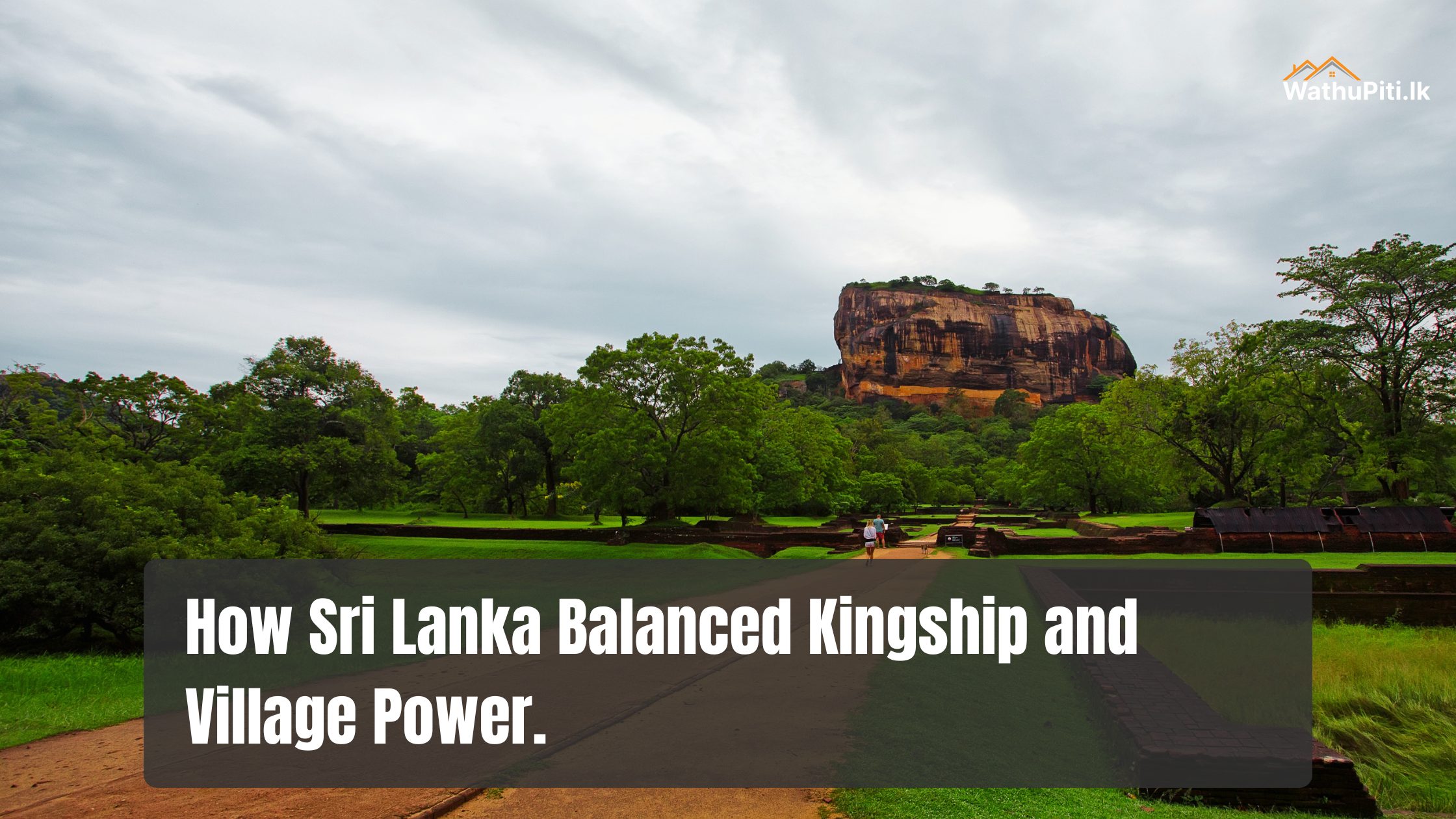
How Sri Lanka Balanced Kingship and Village Power.
Sri Lanka’s early history shows a unique political system where strong kingship existed alongside active village-level governance. Rather than one dominating the other completely, both systems worked together to maintain order, support agriculture, and sustain society. This balance played a key role in shaping the island’s long-standing civilisation.
The Foundation of Kingship in Early Sri Lanka
In ancient Sri Lanka, kingship was the central political authority. Kings ruled major kingdoms such as Anuradhapura and later Polonnaruwa, which became powerful administrative and cultural centres. These rulers were not only political leaders but also seen as protectors of religion, law, and public welfare.
Kingship was deeply linked with Buddhism. Rulers considered it their duty to support Buddhist institutions by building monasteries, maintaining shrines, and protecting the Buddhist community. This relationship helped strengthen their legitimacy and unified the population under shared cultural and religious values.
Although kings held authority over large territories, their power was not exercised in isolation. They depended heavily on local communities and village structures to maintain stability and economic productivity.
The Strength of Village Communities
While kings ruled from major cities, the real foundation of society was the village. Villages were organised communities that managed land, agriculture, and water resources collectively. Most people lived in rural settlements and depended on farming, especially rice cultivation, supported by irrigation systems.
Villages were not passive units under royal control. Instead, they had their own leadership systems, often managed by local elders or village heads. These leaders handled day-to-day administration, resolved disputes, and ensured that agricultural and water systems functioned effectively.
One of the most important aspects of village life was irrigation management. Sri Lanka developed a sophisticated hydraulic civilisation where small and large tanks (reservoirs) were used to store water for farming. Many of these systems were maintained at the village level through shared responsibility, showing strong local cooperation and organisation.
The Connection Between Kings and Villages
The relationship between kingship and village governance was highly interdependent. Kings provided large-scale support, while villages ensured local implementation.
Kings were responsible for building large irrigation systems such as reservoirs and canals, which required advanced planning and resources. However, the maintenance of smaller irrigation networks and farming systems was often handled by village communities. This created a shared system where both levels of society contributed to economic success.
Villages also supplied agricultural surplus and labour to the kingdom. In return, kings provided protection, infrastructure, and support for religious institutions. This mutual exchange helped maintain stability across the island for centuries.
Governance Through a Decentralised System
Although kings were powerful, governance in ancient Sri Lanka was not completely centralised. Authority was distributed across different levels, including regional officials and village leaders. This allowed local communities to manage their own affairs while still being connected to the broader kingdom.
In many cases, village leaders played an important role in implementing royal decisions. They acted as intermediaries between the king and the people. This structure helped reduce administrative pressure on the central government and ensured smoother governance across diverse regions.
The presence of local leadership also meant that villages had a sense of responsibility and participation in governance. This contributed to social stability and reduced conflict between the central authority and rural populations.
The Role of Agriculture and Irrigation in Balance
Agriculture was the backbone of Sri Lanka’s ancient economy. Rice cultivation depended heavily on water management, which required both royal investment and village-level cooperation.
Kings constructed large-scale reservoirs by damming rivers and creating irrigation networks that supported entire regions. However, smaller canals and farming systems were managed locally. Villagers worked together to maintain water flow, repair structures, and distribute water fairly among households.
This shared responsibility created a balanced system where neither the king nor the village could function independently. The success of agriculture depended on cooperation between both levels.
Cultural and Social Stability Through Dual Governance
The balance between kingship and village power also contributed to social harmony. Kings provided a unifying identity through religion and state authority, while villages maintained everyday traditions and community life.
Buddhism played a major role in connecting these two levels. Royal support for religious institutions reinforced moral values, while village participation in temple life strengthened cultural continuity. This shared belief system helped bridge the gap between rulers and rural populations.
Social systems, including family structures and local customs, were largely maintained at the village level. At the same time, kings ensured that laws and broader policies supported overall stability.
Long-Term Impact of the Balanced System
The combination of strong kingship and empowered village governance allowed Sri Lanka to develop a resilient and adaptive civilisation. Even when political changes occurred, the village system provided continuity and stability.
This structure also helped Sri Lanka maintain advanced irrigation systems, strong agricultural output, and a stable social order for many centuries. The balance between central authority and local participation became one of the defining features of early Sri Lankan society.
Conclusion
Sri Lanka’s ancient political system was not based on domination by a single authority. Instead, it was built on a careful balance between kingship and village power. Kings provided leadership, infrastructure, and religious support, while villages ensured agricultural productivity, local governance, and community stability.
This cooperation created a strong and sustainable society that lasted for centuries. The relationship between the throne and the village demonstrates how shared responsibility and mutual dependence can build a resilient civilisation.
References:


